Posted on Leave a comment

Let’s Ditch the Dry Turkey

Can I admit to you, my dear friends, that I sometimes find the Thanksgiving meal boring? There it is. Out in the open. But hear me out. This is one holiday where we are all tied to the exact same meal on the fourth Thursday of November. To make matters worse, usually we use the exact same recipes as we always have and often the same as our mothers did before us.

Don’t take this the wrong way. This boredom doesn’t take anything away from the value and appreciation I place on Thanksgiving as a holiday. Or, for that matter, my love of the month of November.

The Glories of November

November really is an unsung month. It no doubt has middle child syndrome. But like a middle child, November has charming characteristics all its own. For me, it’s a relaxing month. The busy rhythm of summer has ended, and the craziness of December is yet to begin.

I spend more time sipping coffee. Long evening walks watching crisp and clear sunsets become the norm. I start making braises and soups, all the warm cozy foods. I wash windows and organize my closets, taking out all the wool, knitted pieces I’ll need in the winter months. Taking long deep breaths of relaxation, I catch my breath. By the end of the month, I am fully thankful, if for nothing less than for having had a wonderful month.

What’s to Love About Thanksgiving?

As far as the Thanksgiving holiday goes, it has much to offer. First, the purpose of giving thanks is something essential to our well-being. An attitude of thankfulness changes how we view life. In my experience, we always have something to be thankful for, no matter the situation. When we find those things and are grateful for them, it’s like the dawn of a new day.

What’s Not to Love …

All this said, I have to admit I’m not thankful for canned sweet potatoes topped with toasted marshmallows. I’m not super thankful for glazed carrots or green bean casserole, canned cranberries, shredded carrot jello, or grocery store pie. While I appreciate the tradition that goes along with the decades of serving these menu items, I can’t help but think they’re boring. And even though all the mothers that have gone before us (God rest their souls) might disagree, they’re not that tasty.

What I’m Doing About It

It is with this combination of boredom and a healthy respect for tradition in mind that I have ventured on a quest. How do I un-bore Thanksgiving dinner and add some zing to the menu items, all the while keeping it fairly low on the labor-intensive spectrum?

Dessert

Let’s start with dessert because, well, why not? The capstone is always a good place to begin. I’m considering whether to remove pie from the menu altogether … There has to be something more spectacular that can serve as a replacement. But the stakes are high. If I don’t succeed at dessert, my family may boycott the meal altogether.

To make the day flow easier, I’m going to choose a dessert I can make a day or two ahead. The first thing that pops in my mind is pumpkin cheesecake. Cheesecake needs to be made in advance, and my recipe is delicious. However, it is still mildly boring, plus I’ve made it for Thanksgiving before. Perhaps pumpkin tiramisu or a pear galette. Either would be delicious and interesting enough.

But I finally settle on a goat cheese cheesecake topped with cranberry gelee and salty/sweet pecans. Oh, and individual persimmon pudding cakes served with cinnamon whipped cream. Cranberries and persimmons are two of my favorite fall fruits. The creamy cheesecake counters the freshness of the cranberry gelee, a true show stopper. As a nod to those who must have pumpkin on Thanksgiving, I may have a few individual pumpkin custards sitting in the wings.

Turkey

Moving backwards in the meal is the piece de resistance, the turkey. I have to tell you that I could probably write a book named “55 Ways to Cook a Turkey.” I’ve tried them roasted right side up, upside down, brined, marinated, high-heat roasted, slow-roasted, stuffed, unstuffed, rubbed with herb paste under the skin, rubbed with herbs on the outside … I’m always searching for ways to make the turkey both flavorful and tasty. But the preparation must be simple. There are enough parts to this meal that I don’t want a complicated turkey recipe.

The challenge is keeping the turkey meat moist while also making it delicious and unique. After much thought and research, I am going to use a hybrid of one of Thomas Keller’s recipes, Bouchon Roast Turkey. Here he uses a mix of techniques to achieve two of my three criteria. This turkey will be both moist and delicious.

He starts by soaking the meat in a brine mixture of lemon, garlic, herbs, pepper, and kosher salt. This particular combination of ingredients will really amp up the flavor of this bird. He then uses a high heat method to cook the turkey. The theory behind doing this is that the higher temperatures of the oven seal the juices inside the bird, making it more moist.

The Accoutrements

As far as the side dishes go, they happen to be the favorite part of the meal for most of my family. The edict from my clan has always been, “Don’t mess with the side dishes!” Thus, my challenge is to change things up without changing things up too much.

Cranberries

Typically, I like the cranberries to be unadulterated, cooked with just water and sugar. This year, though, I am going to make a second cranberry sauce with added apples. I’ll substitute apple cider for some of the water and add a finely chopped apple to the cranberries before cooking them. The extra sweetness from the apple and cider is enough that I won’t need to add any sugar in the recipe—always a good thing.

Sweet Potatoes

I’ll whip the sweet potatoes into a puree, adding a bit of cream and mascarpone cheese to make them creamier and increase the richness. The marshmallows will stay in the pantry. I prefer sweet potatoes to be on the savory side of the flavor wheel.

Stuffing

Stuffing is something one never wants to skimp on, so this year I’m going to amp up the classic version using dried sourdough bread from a local bakery, sautéed Italian sausage, garden onions and celery, and an abundance of herbs harvested from my garden.

Green Bean Casserole

In homage to certain members of my family, I’ll make green bean casserole. Mine, however, will use fresh French green beans, mushrooms, shallots, and thyme sautéed in butter and sherry vinegar, then finished with heavy cream, salt, and pepper. I’ll cover it with crispy fried shallots. Now that is my kind of green bean casserole!

A Spot of Something Sweet

Lest anyone get faint from hunger during the football game, I am adding a new iteration of snickerdoodles, chai-spiced. They’re a standard snickerdoodle dough rolled in a mixture of sugar, cinnamon, cloves, nutmeg, and cardamon. What a delicious riff on a classic cookie.

I Can’t Forget the Dinner Rolls

Alas, I would be remiss if I failed to mention everyone’s highlight. These homemade dinner rolls entered my family’s Thanksgiving tradition more than twenty years ago. They have been deemed essential, and thus, they must be freshly made on Thanksgiving Day. God forbid day old dinner rolls …

You wonder why these humble rolls hold such a hallowed spot? Firstly because their aroma when baking is what wakes everyone up in the morning. Coffee and fresh dinner rolls enjoyed in your pajamas are a highly valued tradition in our house. In the evening, they become a necessary component of the ubiquitous turkey sandwiches. With all this early and late ingestion of dinner rolls, you are no doubt wondering if there are enough for the actual meal. Don’t tell anyone, but I tuck a certain percentage away only to bring them out for the Thanksgiving meal itself.

There you have it. My rough and tumble plan for this year’s Thanksgiving meal. Hopefully you glean a few bits of inspiration from my slightly askew interpretation of the meal. Now that this planning is out of the way, I’m going to sit down with a cup of tea and try to figure out how to make my December more like its easy-going sibling, November.

Posted on 1 Comment

Persimmon – The Unsung Holiday Fruit

Holiday Memories

As I dipped my spoon into the steamy rust-colored persimmon pudding, the rich, spicy aroma wafted from the dish. A little of the accompanying cream ran into my spoon and mixed with the pudding. The flavor of this unique fruit and dessert signify the holidays for me. 

For many years my sister-in-law, an Indiana native, has given me the gift of a tub of Indiana wild persimmon paste. It usually arrives in the fall, typically just before Thanksgiving. My favorite thing to do with this paste is to turn it into persimmon pudding. I have tended to make this delicious pudding as one of the desserts for Thanksgiving dinner. When served warm with a bit of fresh cream overtop, it is divine. 

What is a Persimmon?

American persimmons are native to southern Indiana and ripen in September and October, making them the perfect holiday fruit. When ripe, their flavor is nicely sweet in a complex sort of way.

Unfortunately for me, I don’t live in a part of the country where persimmons grow, so I pick them up in the grocery stores, which are currently carrying both the Fuyu and Hachiya varieties.

This year I’ve decided to branch out and mess around with using persimmons in other ways. The Fuyu variety I purchased this year is still firm when they are ripe, so I figured they would hold up well when roasted or broiled. The oven heat will serve to concentrate the flavors and amp up their already sweet nature. 

Roasted Persimmon Salad

I start by slicing one of the persimmons into thin wedges. Then I brush the wedges with olive oil and roast them in a high heat oven (425 degrees F) until they turn brown on the edges. 

While these are roasting, I whisk together a citrus/olive oil vinaigrette, slice some roasted beets and a clementine. Once the persimmons are ready, I arrange all the components on plates. I add Lacinato kale and microgreens and then drizzle vinaigrette over the top. Crushed black pepper and chunky sea salt round out the dish. This gorgeous deconstructed salad will serve as the first course at one of my holiday dinners. 

Broiled Persimmons

Let’s now move on to my next idea, broiling them much like I would fresh plums. For this I take slices of a crusty baguette and top each slice with a piece of soft triple cream cheese. I then place a thin sliver of fresh persimmon on top. I again brush the persimmon with olive oil. 

To add a little sweet crunch, I sprinkle on a bit of raw sugar. I place them under the broiler, and a few minutes later out come the prettiest crostini I have seen in a long time. The sweet roasted fruit proved to be a great counter to the pungent cheese. A new go-to hors d’oeuvres is born.

Spilling Persimmons Over Goat Cheese

The inspiration keeps flowing with my next plan for my persimmons. I love warm spilling fruits. For this I usually take fruits like plums, pears, peaches, or berries and combine them with sugar, lemon juice, and vanilla. After gently simmering them for a few minutes on the stove, the fruit breaks down and forms the most delectable sauce. 

I can use these spilling sauces over a myriad of dishes including pound cakes or olive oil cakes, cheesecake or panna cotta, goat or brie cheese, or prosciutto on a savory tart. I can also use it as a marinade and dipping sauce for roasted pork or chicken. 

It turns out that persimmons lend themselves perfectly to this application. When simmered with a little sugar, lemon juice, and a pinch of salt and then pureed with the stick blender, the persimmons make the prettiest and most delicious sauce. I spoon some over a log of goat cheese and serve it with baguette slices. What a perfect start to my holiday culinary journey.

So the Creating Continues 

Persimmons, a seemingly forgotten fruit, prove to be versatile, delicious, and beautiful. They have definitely earned a place in my holiday repertoire alongside the other winter fruits such as pomegranates, oranges, pears, and grapefruit. They have even made an appearance in my newly released holiday card collection. I’m sure I’ll be dreaming up other dishes with this fruit soon. Dehydrated persimmon chips, persimmon salsa chutney, fruit leathers, persimmon jam, persimmon sorbet, persimmon cocktails… Persimmon prosciutto pizza, anyone?

Posted on Leave a comment

An Unconventional Holiday: Pies, Tarts, and Crusts

A French Thanksgiving

The year was 1977. My parents, brother, and I were spending the year in Strasbourg, France. As the end of November neared, we started to think about how we were going to celebrate Thanksgiving. In discussing with friends, we realized something we should have already known, that Thanksgiving is American. No other country celebrates this holiday. In France the fourth Thursday of November is like any other Thursday in the calendar year.

The simple act of purchasing a turkey proved futile. As it turns out, turkeys are an American phenomenon. We located cranberries (also a North American thing) and pumpkin, and so a Thanksgiving feast was cobbled together.

In an unconventional situation, we made the intentional decision to pivot, to do our own version of this meal, Alsatian style, and use what was available in the bountiful French markets. A plump chicken became the entree. We filled in with locally available items. That year was an adventure, and the Thanksgiving holiday was in keeping. We had great fun making up our own French version of a meal that typically remains rather set in stone.

Allspice cinnamon scented custards with sweet potato crumbles.

Our Minimalist Holiday

As we approach Thanksgiving this year, I can’t help but remember that meal in France. This year, we are being asked to do something very different, to scale back our Thanksgiving celebrations. We must pivot and create a different sort of holiday.

In this spirit of minimalism, the idea of small bits or portions becomes an enticing concept. By creating small desserts just for you and those in your home, you can explore untried recipes. Consider venturing outside your comfort zone. Since this isn’t the year you are feeding 20 at the dinner table, experimenting is in order.

Single serving items such as mini pies or tartlets can be both fun to make as well as flexible for a small group. The individual nature of these desserts also make them ideal for sharing with others, be it neighbors, a family member, or a friend who is isolating and can’t be with loved ones this year.

Allspice cinnamon scented custards with sweet potato crumbles.

Understanding Pie Crust

Let’s take this opportunity to talk about how to make a tender flaky pie crust. The crust is the foundation of any pastry. I’ve obsessed for decades to perfect the flakiest and most tender pie crust. Let me begin by explaining flakiness. In any baked good, it’s the fat that makes for tenderness. When making cookies or cake, the softened fat incorporates into the mixture so that the particles are very evenly dispersed throughout the dough. This causes the end product to be evenly tender.

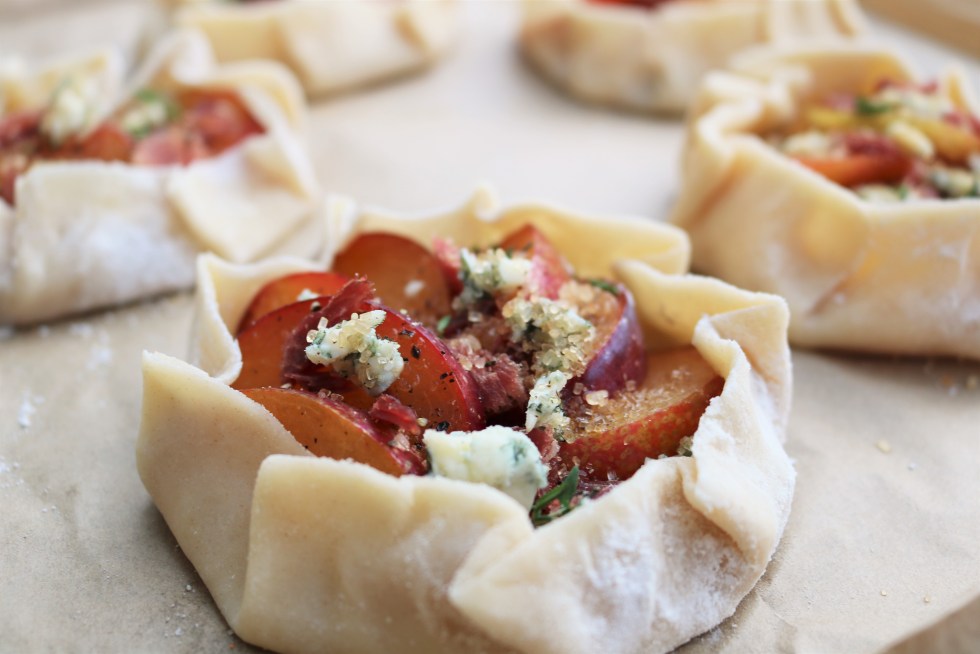
Plum, prosciutto, and Gorgonzola galettes ready to go in the oven.

With a baked good that needs to end up flaky, you need to take some specific steps in the process of making the pastry dough. In this situation, you want the fat to stay fairly firm. You do not want it to be evenly dispersed but rather to remain in small pieces. Thus, when rolled out, it forms long, flat strips in the dough. There are variations to this dough, but this greater category is called laminated dough, meaning the fat is laminated throughout the dough. The same general concept applies to all flaky pastries, including croissants, puff pastry, turnovers, and of course, pie crust.

The finished plum, prosciutto, and Gorgonzola galettes.

Much discussion remains in the pie crust baking world (this, most likely, consists of a very small contingent of people), about which type of fat to use, lard, butter, and/or shortening. For several reasons, I fall into the “all-butter” camp. Butter makes for a very flaky end product. This is because when baked, the water that is in the melted butter creates steam inside the dough, creating the characteristic flakes in your pastry. Secondly, butter tastes like, well, butter. And who can argue with that?

Making the Pie Crust

To achieve this flakiness, there are several steps that have to be taken. First, make sure that your butter is firm to the touch. Leave it in the fridge until just before you start to make your pie dough. The next essential step is to fill a bowl full of ice water. I do this at the beginning so the ice cubes can start to melt, making the water as cold as possible. After you prepare your water, mix the flour and salt together in a bowl. Slice the larger portions of butter into tablespoon-sized pieces.

Allspice and cinnamon

Add these to the flour, mix with a pastry blender, two knives, an electric mixer, or even your fingers. Watch out on this step. Only mix until the fat is in pea-sized pieces. This can happen very quickly and you don’t want to over-mix. Next, add the ice-cold water. Again, be careful on this step to not over-mix. The dough should be just coming together, very “piecey” at this point. Tip the dough out onto a floured surface and with your hands, bring it together into a ball. There should still be visible pieces of butter in the dough.

The Next Steps

At this point, I rest the dough in the refrigerator for at least 30 minutes. This resting allows the gluten to relax, making it much easier to roll out. To do this, I divide the dough into the amount I’ll need for rolling out later. Usually a single recipe makes 2 crusts, so you would divide the dough into two balls. I flatten these balls into disks and wrap with plastic wrap. Place them into the refrigerator. You can also freeze the dough at this point for use at a later time.

When it’s time to roll out the pie crust, simply place the disk on a floury surface, using a rolling pin, roll, starting in the center of the disk, working out in all directions. As you roll out the dough, you should see the little pieces of fat flatten into strips. This is what will produce flakiness. Here is my recipe:

Cami’s Pie Crust

Note: the water used can fluctuate by a tablespoon or so, depending on whether the dough is being mixed by hand or by machine.

Ingredients:
2 ½ cups all-purpose flour
2 teaspoons granulated sugar, if desired
1 teaspoon salt
14 tablespoons butter, chilled, divided into pieces
6 tablespoons (approximately) ice water, as needed

  1. Mix flour, sugar, and salt together in a bowl.
  2. Working quickly, mix in the pieces of butter using a pastry blender until they are small pea-sized pieces throughout the dough.
  3. Sprinkle in the ice water several tablespoons at a time, working the water into the dough. Don’t overmix. Gather the dough into a ball, working in a circular fashion, form two disks. Wrap in plastic wrap or wax paper and refrigerate for at least 30 minutes.
  4. Roll dough out on a floured surface, working the rolling pin from the center of the disk out toward the edges.
  5. Once the crust is rolled out, use it as desired, following the directions of the pie or tartlet recipe you are making.

New Thanksgiving Pie Fillings

The frosting on the cake, so to speak, for pies, is the filling you choose to put into your amazingly tender flaky crusts. I tend to gravitate toward the fruits that are in season at Thanksgiving. Many of these are unheralded, the reasons for which are beyond me. One of my favorites is pears. Pears are at their peak in the end of November with many varieties from which to choose. They create a delicate, creamy flavor when baked. Versatility is a key attribute as they move easily between hors d’oeuvres and desserts.

Other fall picks you can include are apples, plums, quince, persimmons, cranberries, figs, kumquats, sweet potatoes, or squash. Just like pears, these all move easily across the spectrum of a meal. They are as perfect used in an appetizer, as a compote for a roast, as a topping or filling for a dessert. These cool days also lend themselves to the richness of nuts. Currently, I’m particularly fond of hazelnuts, pecans, walnuts, and chestnuts. Incorporating one of these into a chocolate tart will solve most of the world’s problems. At least it will be a delectable distraction. I could go on, but you get my point. The options are as endless as your creativity. This is a golden opportunity for you to try some of these lesser known ingredients. You’ll be pleased and surprised at the ease at which you may usher a new favorite into your repertoire.

A Thanksgiving for Trial and Error

I’m not sure where the saying, ”As easy as pie” came from, probably from a grandmother who had been making pies for 50 years. It’s not actually the most accurate statement. A more honest saying would be, “Pie isn’t easy at all. It’s only a success if you have taken the necessary steps and perfected the art of the flaky crust”. That’s a less than inspiring saying and quite the mouthful. That said, this is the year to practice, to experiment, to pivot, to go out of your comfort zone. Your audience will probably be small, quite accepting of your creations, and possibly rather forgiving if you fall short of success.

Posted on 2 Comments

Celebrate with a Thankful Heart

Tradition

It seems that everyone has stories to tell about their Thanksgiving traditions. The preparation for this meal usually involves several days. Turkeys are bought days ahead. They fill our refrigerators as they thaw. The aromas begin to fill our homes: cranberry sauce cooking on the stove, pies baking in the oven. These are the reminiscent smells that welcome family as they gather.

The actual day of Thanksgiving arises early as the final rubs and fillings are applied to the big bird before we slide it into the oven to roast. If you are like most cooks, you breathe a sigh of relief once this step is done. The day is still early, and the house is quiet. It is the perfect time to sit for a minute and sip some coffee.

Next up, think about the side dishes, the hors d’oeuvres, and last but certainly not least, the desserts. Vegetables need scrubbing, potatoes need peeling, green beans need trimming. Time to start mixing up the dinner rolls. We must always include favorite foods. Is your pie of choice pumpkin, apple, or pecan? Do you eat marshmallows on your sweet potatoes?

Our culinary traditions bring us together as friends and families, but also together as a country. This is the time we remember to give thanks. We give thanks for loved ones, food, warm houses, freedom, friendships. We also think about and give in record amounts to those who do not have loved ones, who are going hungry this November, and who lack a warm house to call their own. This is a time for thankfulness, and out of this full heart comes generosity.

Our Past

The tradition of a harvest festival grew up with our country, starting in the early 1600s. This celebration took many forms in fits and starts before it finally settled in to what it is today. George Washington declared a national day of Thanksgiving on September 25, 1789. This was sporadically observed for a number of years following his declaration.

The idea of a designated Thanksgiving Day, however, was championed by a most unlikely suspect. Sarah Josepha Hale, a poor young widow who then rose to become the editor of the most popular magazine of its time, Godey’s Lady Book, talked about this idea for many years, presenting it to multiple presidents. Finally Abraham Lincoln listened and declared in his Thanksgiving Proclamation in 1863 that the last Thursday of November should be set aside. It wasn’t until 1941, thanks to President Roosevelt, that Congress officially established that day as a national holiday.

New Twists

In our home, Thanksgiving tends to be tradition with a twist. While the basic food items such as turkey, potatoes, sweet potatoes, cranberries, etc, are present at the Thanksgiving table, their form and what dish they show up in is constantly changing. One year cranberries are in the stuffing, the next year they appear in the beverage, the next, in a dessert. Likewise with apples or pecans.

Our turkey may appear green thanks to the herb paste stuffed under the skin or have copper sheen due to being glazed with sweet mix of pomegranate molasses and orange juice. Sometimes we roast it upside down, other times on high heat. Some years we stuff it with apples, onions, lemon, garlic, and sage leaves, other times with cornbread sausage stuffing. Every year is an opportunity to try new versions of the trusty old ingredients.

Trio of cranberry sauces: cranberry pear, cranberry jalapeño, and cranberry fig.

This year the cranberries are going to have some added kick, sauteed with shallots and jalapeno peppers. A second sweet variation will include Bosc pears, quince paste, and ginger root. A butternut squash will be pan-roasted with sage leaves, tossed with fresh mozzarella cheese, and then drizzled all over with pistachio pesto. Our stuffing will be gluten-free by using a base of wild rice.

Roasted butternut squash with fresh mozzarella, sage, and pistachio pesto.

With so much change, does anything stay the same? Yes, the tender, fresh from the oven dinner rolls. These never change. They must show up every year. They are so pristinely baked that a goodly number of them never make it to the dinner table.

Find your own recipe for melding tradition with change. We are a blessed people, so this Thanksgiving, both give and give thanks.