Posted on Leave a comment

Glorious December: The Winter Collection

The frosty grass crunches under my boots as I cut across my lawn. The sunlight is crystalline this winter morning. Daybreak has just arrived; its light sparkles through the branches of oaks and maples. I breathe in the cool air, and it refreshes me down to my core.

The sweet dogs that walk beside me are similarly thrilled to be outside. The noses busily snuffle in the dry leaves, looking for remnant scents of the nightly critters who have occasioned past. Racoons or possums are always a possibility, as are the neighborhood cats. It is an exciting moment when they find a particularly interesting smell.

We are on the cusp of this holiday season, yet it seems surreal. Autumn has been glorious this year. The maple trees were laden with beautiful red and orange leaves. The mornings were cool, but then the day morphed into sunny warm afternoons. All this belying the harsh winter that is certain to come.

I glance up to see a blue jay grabbing an acorn from a big old oak tree and flitting off. Acorns are an important food source for blue jays, especially in the winter. Blue jays spend the warmer months burying acorns around and about. They will only remember where a fraction are, resulting potentially in many baby oak trees. Fondly, I think of what an unsuspecting gardener this bossy bird is.

We return from our walk back to our festive house. The ornamental hawthorn trees and holly winter berry bushes are draped with twinkle lights, a wreath bedecks the side of the house, and Scandinavian stars hang delicately in each of the windows. When lit, they bring magical light to the rooms within as well as the darkness outside. My intention with our lights and decorating is to pull people inside. They say, “Come in, stay a bit, let’s share a freshly baked goodie and for the moment forget our respective to-do lists.”

My cozy home, a warm cup of tea, holiday jazz tunes, the soft alpaca throw I purchased at a darling shop in Big Timber, Montana, the latest knitting project on my lap, these are the things I bask in during these weeks leading up to Christmas.

Here is my seasonal card collection, with four notable additions for winter 2023 designs, including lodgepole pines, a blue jay, holly winter berries, and a snowy home.

I light a fire in the fireplace, throwing in some lodgepole pine cones I gathered this past summer in the Montana Rockies. They quickly snap and crackle when lit, making for wonderful fire starters. As the room warms, I curl up on the couch, soaking in the beauty of it all. The calm, the festive, the hectic, the beautiful — all memories to be stored away. This is December. Glorious December.

Posted on Leave a comment

Stories of the New Summer Flowers

How is it that something so bright and colorful can bring a sense of calm? I admire the tiny florets that combine to form the grand hydrangea and the tumbling clematis vining up the fence. They are at once complex yet simple.

As the cool spring has moved to toasty summer, the buds have grown to ornate blossoms. The sun kisses them, and they grow larger while their color brightens and deepens. When these flower friends greet me each day, they lift my spirit and bring me peace and joy.

Flowers appear simple, yet they are the lynchpin in a complicated food web. For example, as I write these words, two dainty hummingbirds and a rotund bumblebee dart from flower to flower on the honeysuckle vine right outside my door. Flowers truly are the insect and bird world’s kitchen, or should I say dinner plate.

Clematis

For years, I’ve had a whimsical clematis vine climbing my fence. Its delicate tendrils curl around the wrought iron with deep purple flowers poking out here and there. Politely reaching up and out, it slowly expands its reach every year. I try to tell it, “grow faster, grow higher, my beautiful vine. You can never be too much for me.” But it takes its sweet time, growing little by little as the years unwind.

Blossoms envelop my clematis vine for many weeks throughout midsummer. I find myself dreaming up new spots where I could place a trellis and tuck in another variety.

With all its colors and variations, clematis is a vine that the gardening world has been collectively enamored with for centuries. Hailing originally from Asia, it was brought to Europe in the early 1800s and finally made its way to the New World. It is regarded by many as the Queen of Vines, and that it is, possessing both grace and beauty.

Hydrangea

For myriad reasons, I recommend planting hydrangeas more than any other bush. They are like that person in your life who’s practically perfect in every way. Not only are the flowers beautiful, but their bloom times extend for months, from early summer through to the next year when you finally prune them. Additionally, they get more beautiful as they age, often going from ivory or pale green to pink or even deep rose as autumn progresses.

Many plants, trees, and bushes are suited to particular climates, called hardiness zones. Being in a northern climate, there are several southern plants for which I have intense zone envy. Some include the more ornate hydrangea varieties, like the lacecap and mountain hydrangea.

These jewel-toned beauties have graced southern gardens for eons. However, thanks to our busy scientists, more of these colorful varieties are becoming available in the northern zones.

Dahlia

If you’re looking for just one very good reason to live in a southern hardiness zone, it’s the ability to grow dahlias as a perennial. These plants sport massive pom pom-like blooms that can stand several feet tall. Humans have fawned over dahlias for centuries, and for good reason.

The flowers come in every color of the rainbow (except blue and black). They can be a dainty two inches in diameter or a massive 10 inches across. Hailing from Central America, dahlias are the national flower of Mexico.

While I can’t quite imagine digging up this beauty just so I could sauté its root, it was originally classified as a vegetable thanks to its edible, mocha-tasting tuber. I guess the powers that be agreed with me because it was eventually reclassified as a flower. One of its most favored qualities is its late summer bloom time. Right when other flowers are starting to fade, dahlias are going strong, and they continue right up until the frost.

Lavender

As I breathe in the deep purple color and the intoxicating aroma of my newly gathered lavender bouquet, my worries melt away. On gray and rainy days, I often light a lavender-scented votive candle and let the fragrance waft throughout the house, creating a warm, cozy mood.

My love for lavender runs deep, and the scent elicits a deep emotional response in me. I can’t get enough of it. Whether it is in a sachet in my woolens, in the dish soap by my sink, or in a vase on the counter, it’s the one flower I come back to when I’m looking for something special. Maybe it allures me because my northern clime prevents me from growing vast purple fields. Lavender’s relative scarcity up here makes it that much more special.

I suppose until the day I can own a lavender farm, I’ll resign myself to filling my house with lavender-scented tea, lavender candles, lavender soaps, lavender honey, lavender lotion, and lavender water for ironing…Is there ever too much?

The New Summer Flower Art Collection

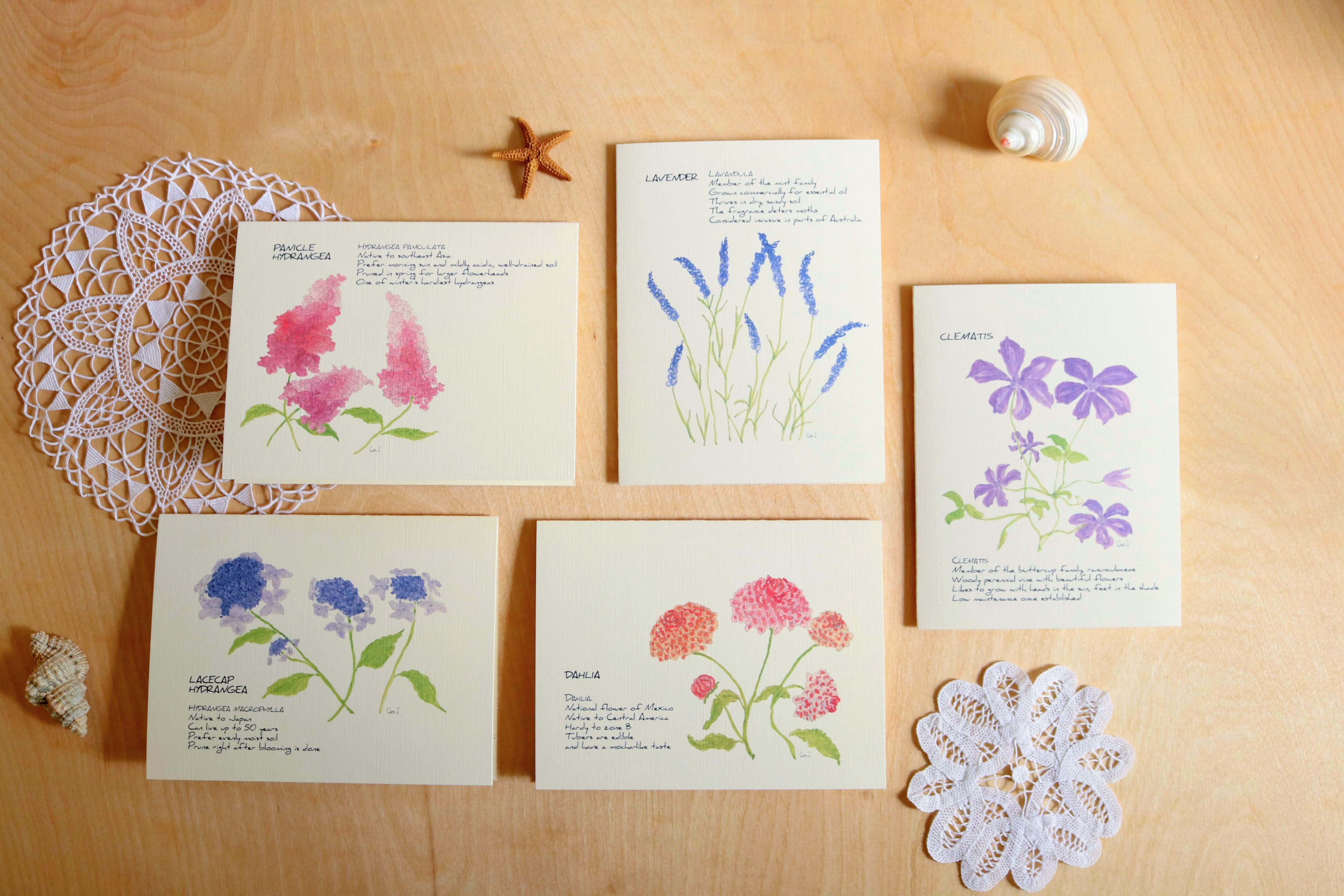
Now that you see the inspiration behind all of these incredible flowers, you can see why I had to paint them. We really can never have too many flower designs to choose from so here are five more: clematis, lacecap hydrangea, panicle hydrangea, dahlia, and lavender. I hope you enjoy these new designs as much as I enjoyed painting them.

And whenever you sit down to write a note in one of these cards, no matter the time of year, I hope it takes you back to those carefree summer days of sipping iced tea in the garden while the hummingbirds dance all around you.

Posted on 1 Comment

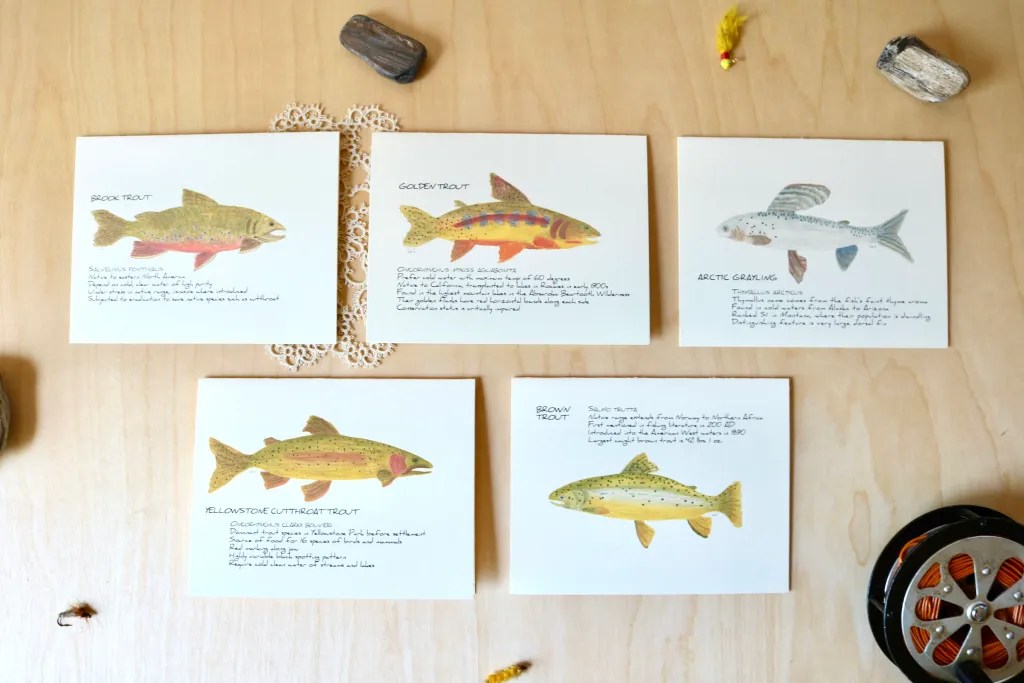
The Trout Collection: Fly Fishing and the Waters of My Youth

As a little girl, summertime brought my family to the Absaroka-Beartooth Wilderness of Montana, where the primary pastime was fly fishing. Still today, the memories remain etched in my mind. I would sit on the rocky bank of the river, watching my father work his way upstream. He elegantly whisked his fly rod back and forth, the line barely grazing the top of the fast-flowing water. If he got lucky, an unknowing rainbow trout would mistake his fly for dinner and take a bite.

My dad famously advised anyone learning to fly fish to “pretend you’re holding a whiskey bottle under your arm. Work your rod back and forth while pretending to hold this bottle.” Now if you knew my father, you’d know him as a borderline teetotaler, not wont to indulge in the beverage. Thus he probably never actually owned said whiskey bottle, making his advice all the more humorous.

Golden Trout

Fly fishing stories and lore intertwined into the fabric of my upbringing. I remember hearing of a handful of high mountain lakes, accessible only by off-trail hiking, that were full of large golden trout. These elusive beauties were always deemed to be the ultimate capstone of trout. As you probably can imagine, these trout remained unreachable and thus safe from our fishing rods simply because we could never get our heads around bushwhacking over mountains to reach them.

Yellowstone Cutthroat Trout

Just a tad closer to our flies and tippets were the yellowstone cutthroat trout. This beautiful trout is distinctive for the bright pink splash of color around its gills and down along its sides. Even though they are considered native to the Yellowstone Park watershed, they historically and naturally migrated across the continental divide from the Pacific drainage into the Atlantic drainage, specifically the Yellowstone Park area.

Only very occasionally has a cutthroat been caught by a member of my family. When we stumble upon these beauties, we immediately release them back into the waters from which they came. Since we’re usually fishing in Montana rivers or streams, per that state’s regulations, we can’t keep them anyway. With such careful management as is happening in the states whether they’re found, these gorgeous fish will continue to flourish and multiply.

Arctic Grayling

One of the most captivating trout designs I’ve painted has to be the arctic grayling. Their too-big-for-their-body dorsal fin gives them a comical air. Then their thin stripe of pink along the edge of the fin is the perfect finishing touch, not unlike a hint of lipstick elevating your look from “everyday” to “evening wear”. Their little splashes of pink and random black dots remind me of a toddler playing with forbidden make-up.

The arctic grayling, while relatively common in Alaska, is quite scarce in the lower 48 states, found only in a handful of high mountain lakes in Montana. Because of this, I’m sad to say I’ve never seen one of these in person.

Rainbow Trout

Ah, the rainbow trout! Possibly the most caught and most talked about type of trout in my fly fishing circle. Every time I see the gorgeous rainbow stripes running down the sides of these trout, I remember again how special these fish are. This beauty graces our eyes for only a few minutes, as I run with the catch-and-release type of fishermen. Thus, these beauties always quickly return back to the waters from whence they came. However short and sweet our encounters, they never fail to delight.

Brook Trout

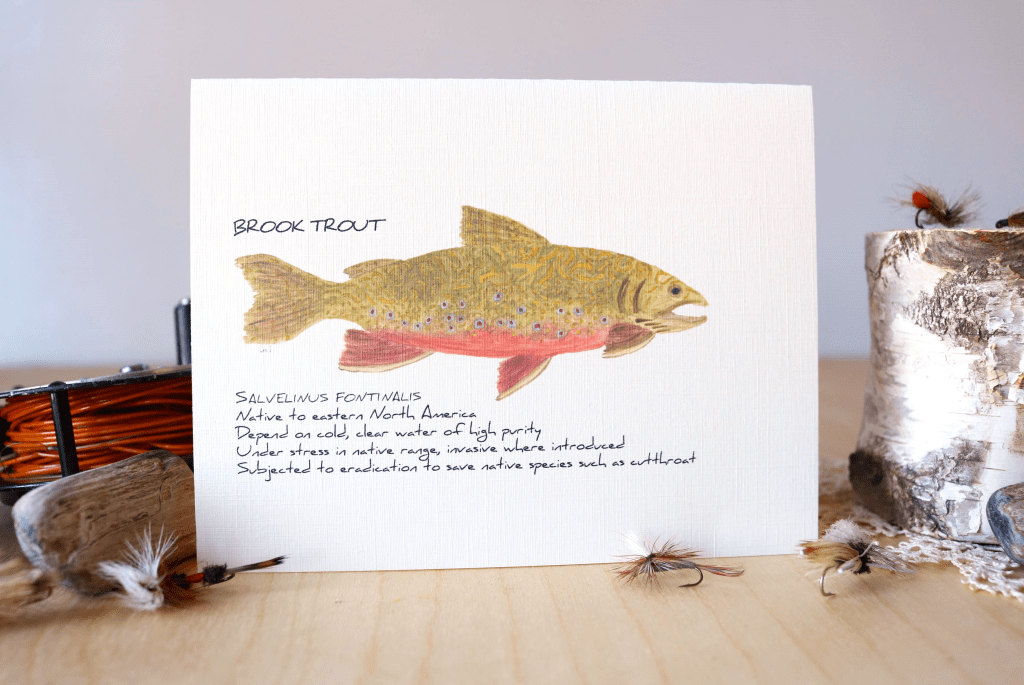
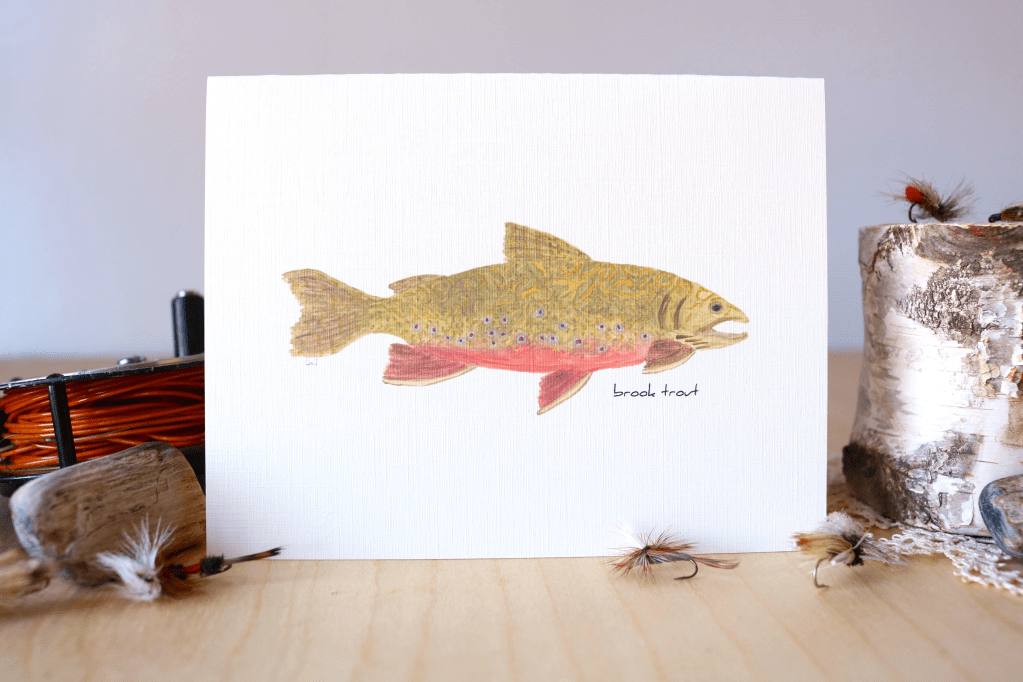
It would seem that brook trout have a bit of an identity crisis. If you live in the eastern United States, where they are under stress, you adore this fish. However, those of us in the mountainous western states don’t have quite so much appreciation. That’s because the brook trout’s ability to flourish is causing populations of native trout to decrease. No matter your level of affection, you can’t help but admit they sport a captivating pattern of yellow and red splotches on their sides. Their squiggly spots made them quite enjoyable for me to paint.

Brown Trout

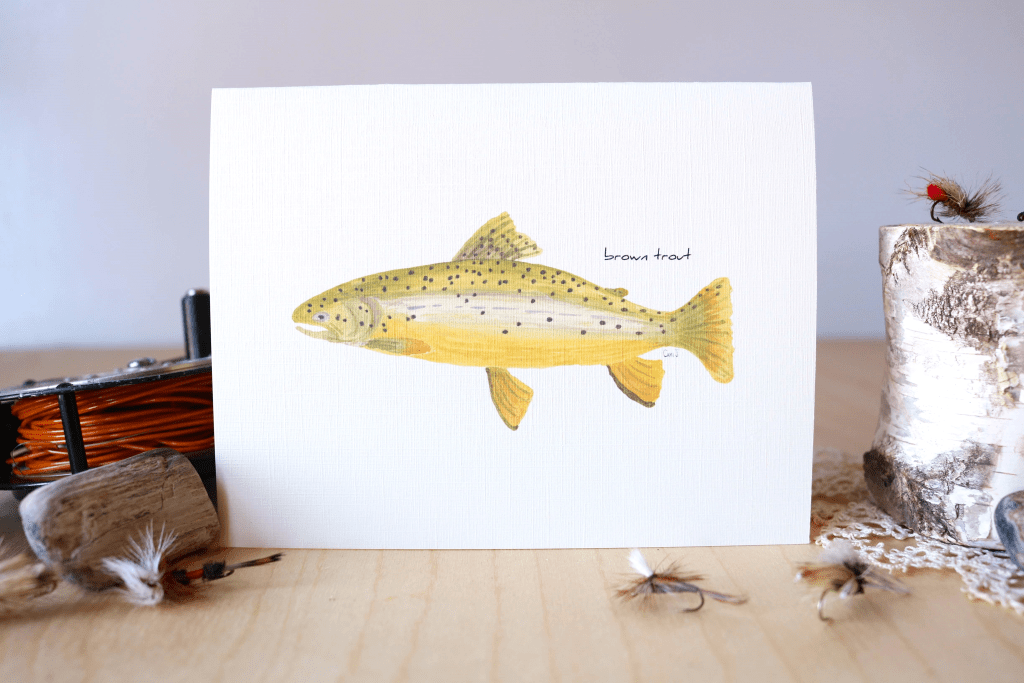
Finally the brown trout, the most spotted of all the trout I painted. I love the coloring of this beauty, with its buttery tan lower abdomen that morphs into brown higher up on the body. Brown trout originated in Europe and were transplanted to the United States in the 1880s. These behemoths run an average length of 12 to 20 inches. Although they can be found in tributaries, they prefer to hang out in bigger waters. They are wily and can be elusive, making them “the one to catch” for many anglers.

The Trout Art Collection

It was pure joy to paint this trout series. Not only do the trout themselves hold a sacred place in heart, but their habitats do as well. Some of my favorite places in the world are the clear waters of the rivers and lakes they call home. The sound of the rushing stream, the smell of lodgepole pine, the flicker of a trout flipping its tail fin above the water during the evening rise…This is where my soul lingered as I painted these beauties. And like a mantra echoing in the recesses of my soul, I heard the voice of my father saying, “Now don’t drop that whiskey bottle!”

Posted on Leave a comment

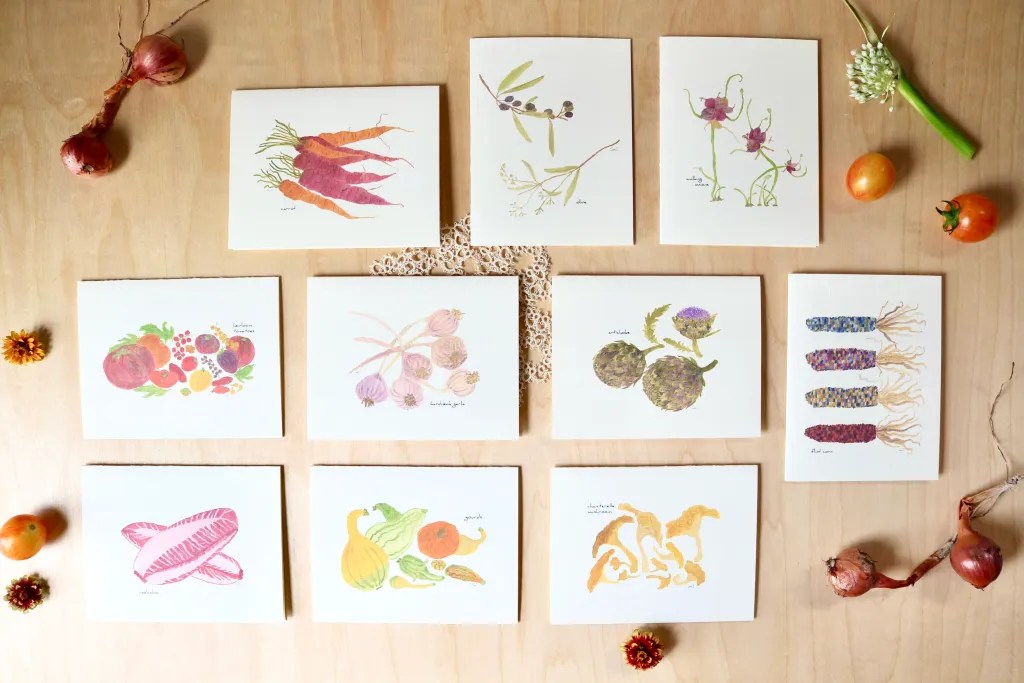
Fall Art Release: Vegetable Watercolor Collection

The Hum of Autumn

The dawn is crisp as I step into my garden. This coolness is new and refreshing. I know the day will heat up later, but for now I contentedly pause to breathe in the chilled air. I arrived at the garden early today to assess which vegetables are ripe and ready to be turned into rich pots of sauces or pickled into crunchy delicacies.

Something about the late summer days calms me even though the days and nights are full with harvesting and canning. Maybe it’s because the heat of summer is over and all that I’ve been preparing for since early spring is now bearing fruit.

Harvesting Garden Vegetables

Evenings and weekends hum along with a similar tune. I open the kitchen windows, turn on jazz saxophone music, and start creating from the garden bounty. It’s my happy time. What have I made before that I want to repeat? What new venture will I try this year?

Carrots

Back in the garden, I start with the carrot patch. I planted three varieties this year. Nantes and Chantenay are the two orange carrots I chose. They are trusty producers, always sweet and juicy. The other variety I planted is Purple Dragon. This is such a beautiful carrot, purple on the outside and orange on the inside. It’s always a crowd pleaser sliced into a salad.

Tomatoes

Across the aisle from the carrots are the tomatoes. Let’s just say I went a little overboard when I ordered my seeds last winter. It was a frigid day in the depths of January when I perused the seed catalogs and websites. This is a dangerous combination for me, as I’m bound to start dreaming of summer and a prolific harvest.

Now, as I look over my tomato collection, I’m glad I planted so many varieties. Most are interesting and delicious. I have what I call the United Nations of tomatoes and peppers.

They hail from most corners of the globe—with many countries in Europe, eastern Europe, the Mediterranean, and the Americas represented. Some of my favorite medium and large tomato varieties include German Pink, Japanese Black Trifele, Black Sea Man, and Dester. I’m newly addicted to two cherry tomato varieties, Blondkopfchen and Sunrise BumbleBee.

Garlic

Planting my garlic has become a cherished tradition for me. I spend many evenings scrolling through the garlic producer’s websites, reading about each type, and trying to choose what varieties to plant. Of course because of where I live, I have to pick from the hardneck options, which thrive in cooler Northern climes. This year I played it safe with the reliable Music variety, and I ventured into the unknown with Georgian Crystal, Pehoski Purple, and Chrysalis Purple.

Radicchio

Every year I challenge myself by planting a new type of vegetable in my garden. One of my favorite introductions was radicchio. This is such a sturdy little plant, whose best trait is that it shines in the very late fall when the days are cool. Radicchio is an Italian chicory. It’s delicious sautéed and tossed into risotto along with Parmigiano-Reggiano and pancetta. The leaves’ complex bitterness offsets the creamy richness of this dish. In addition, radicchio has been the subject of many experiments in my cooking, its flexibility making it an asset to any garden.

Mushrooms

On summery Saturday mornings, I hustle into line at the local farmers market to stock up on mushrooms. In my town, a local grower offers several varieties of unique mushrooms, and Chanterelles have become one of my favorites. They can form the base of a rich, savory bisque. They are heavenly when sautéed in butter and white wine and then finished with truffle salt and served over warm brie. Chanterelles are a mushroom I return to time after time, and for good reason.

The Vegetables of Fall

Autumn vegetables: from artichokes on my hors d’oeuvres platter to the bundle of flint corn gracing my front door, this group of vegetables is in a league all its own. They shine in both beauty and flavor. They elevate my cooking game. I say that tomatoes are my favorites, but that’s not really true. After all, then I’m abandoning the peppers, olives, onions, and squash in my life, and I could never do that.

These vegetables are at their delicious height right now, and I can do nothing but slow down and savor their bounty. In the spirit of these bountiful garden harvests this fall, I’m sharing my gourmet and autumn vegetable greeting card designs with you. I hope you find these pieces of art will bring joy to each person you send them to. Visit my shop to view the designs available in this new card collection.

Posted on Leave a comment

The Story Behind the Mountain Wildflower Collection

Wildflowers of My Life

Mountain wildflowers have been part of the formative memories in my life. Not only did they proliferate on the dry mountainside of our Colorado home, but they have been ubiquitous on our mountain hikes and backpacking trips. Whether it was Montana, Wyoming, Colorado, or New Mexico, the native flowers that have been a part of my life are both tenacious and beautiful.

The Blue Hue of Lupines

Wild lupines transport me back to Montana, when in the early summer, cerulean violet lupine flowers begin to cover the mountain valleys. They form a luscious carpet. The meadows surrounding my family’s cabins take on a blue hue as all these iconic flowers come into bloom. 

Many years ago, my dear aunt Joyce even named her cabin after them, Lupine Lodge. When I think back on lupines, I remember all the summers spent in Montana from the time I was a young girl to now. 

The Bitter Chokecherries of My Youth

It is somewhat of an oxymoron to pick a fruit as bitter and poisonous as the chokecherry only to cook it into something as delectable as chokecherry jam.

I first encountered chokecherries in the days of my foolish youth, when my parents, siblings, and I would stop along the road and pick the Montana berries. We would fill ice cream buckets and then haul them back to the log cabin nestled in the backwoods of the Absaroka Beartooth mountain range. There we would begin the long process of transforming these bitter berries into luscious jams and syrups. 

Backpacking with Thimbleberries 

Likewise, thimbleberries have been part of many a mountain hike. The day typically goes like this: we’re walking along the trail, maybe having just crossed a hot sunny rockslide. We progress into a shaded area, and there’s a small mountain stream that runs next to the path. 

Billowing among the undergrowth are thimbleberry bushes. Of course, we stop, nibble on some for a few minutes, take a big swig of water from our bottles, then start moving again. This scenario could repeat itself over and over depending on how much of a hurry we’re in. 

Thimbleberries to me represent a refreshing pause for a fatigued body. They are a fresh respite to a hot day and a touch of nourishment to our increasingly hungry stomachs. 

Beauty on the Edge of a Mountain

Our house sat just back from the edge of the steep Rocky Mountain foothills of Colorado. The hills were stony with clusters of scrub oak and prairie grasses. Cacti poked their thorny faces out from the rocky soil, just asking you to step on them. 

As I made my way down to the valley below, I couldn’t help but marvel at how so many varieties of wildflowers seemingly thrived in such harsh and adverse conditions. The soil was very poor, and the hillside faced southwest, so it got a beating from the afternoon sun. What moisture did come either evaporated off or ran down the incline. 

Indian Paintbrush

In this unwelcoming xeriscape, wildflowers dotted the hillside, cheerfully beaming their colorful faces. Darling little burgundy Mexican hats, Indian paintbrush, ruby colored penstemon, yellow potentilla, and rudbeckia scattered across the dry slope. 

These wild beauties have adapted to the conditions of their environment. Many of them have long roots that drill down to the moisture and nutrients that are deep below the surface. Indian paintbrush thrive despite the conditions. Being a hemiparasite, this flower piggybacks off the surrounding grasses. They attach themselves to the roots of nearby grasses, which are already burrowed deep in the soil.  

A Flower’s Inspiration 

Is the Indian paintbrush’s stamina and unexpected beauty a metaphor for life? When one fights hard for something, the result becomes particularly striking. Over time, these flowers have figured out not only how to grow, but they’ve learned how to flourish in adverse situations. In fact, for these flowers, their environment isn’t adverse; it’s the norm.

Joy from Wildflowers and Berries

I find wildflowers to be inspiring. When I am huffing and puffing up a mountainside, I look over the steep slopes or high mountain meadows, and I see spectacular beauty in the wildest environments. How can I not breathe easier in their delicate elegance? 

My eyes light up when I see wildflowers in bloom against the stark and vast background they call home. Then the wild berries come as a rare gift in the wilderness when tasted on the edge of a remote trail.

As I sit here, painting within the bleak January landscape, I wait for next summer. I hope my family’s trips into the mountains coincide with the bloom times of our favorite flowers or the ripening of our favorite mountain fruits. 

Until then I draw them, and I paint them, and I offer them for you to enjoy on art prints and cards as well. This is so you can dream along with me. We can wait together for warmer days, for summer mountain wildflowers, for buckets full of chokecherries, for bushes alongside high mountain trails that offer up what little they have so that the fleeting visitor might be refreshed. 

Posted on Leave a comment

Art from the Garden

My Love for Art

In my kitchen hangs a painting of a sprouting potato. An unassuming thing, but it brings me joy. Its creator was Betty Strand, an artist and family friend. I’ve always been enthralled by art. Drawings, watercolors, sketches, weavings, batiks, pottery; the list could go on. My walls certainly reflect this passion, and art takes up residence in every possible area of my home.

As you all know, my fascination with cooking and gardening is all-consuming, and a day doesn’t go by that I’m not dreaming about freshly sliced heirloom tomatoes or something of the sort. So why not tie my love for art with my love for all things food and garden? Thus an idea bloomed.

My original sketches when forming the idea to create garden art. You can see I carried some of my original designs into my later finished pieces. 

As I thought about what I could offer you, my mind went to the passion I have for drawing and painting. If only I could give you a taste of the garden within the home, a reminder of the daffodils and crisp sweet peas of spring when you are surrounded by a January blizzard. The garden and kitchen bring me such contentment, and I hope they will bring you the same. Whether you hang my creations on your walls or send them as a greeting card to a friend, I hope they will brighten each blustery day.

Why I Love Paper

Over the years, as I have wandered through little boutique shops on lazy Saturday afternoons, what always catches my eye is their fine art paper and supplies. I don’t quite know why this is, but I have always had an odd obsession with beautiful, high-quality pens, pencils, and brushes of every ilk.

Don’t even get me started on art paper. Sheets of all sizes and colors stacked in cubbies that line an entire wall. Paper hung in large sheets on racks. The thicker the better, I say, and ideally it has some great texture, as well. Paper is such a simple thing, but I love high quality, thick paper, paper with frayed edges, and envelopes in unique shapes that tie shut with little leather strings.

I no doubt leave the boutique a poorer but happier woman, loaded down with a stack of thick cotton vellums, rolls of paper, several pens, and brushes of various sizes and thicknesses. 

The finished card sets. How do I show paper in a still image? Just rest assured, the paper I found passes the Cami test. Thick, linen-textured, faint ivory color, divine. 

The Creative Process

Drawing and painting is an activity I have come back to time and again over the years. It’s in my bones, a part of who I am. I started off this project by sketching. Then I painted. They were small at first, and then they evolved to larger, more refined paintings that can stand the test of time.

Left: my original artwork as well as some of the original, smaller designs. Top right: close-up of a few of my original ideas. Bottom right: the finished card sets. 

There have been many iterations along the way, and I am sure there will be more. It is my pleasure to introduce you to my initial three collections, selections of favorite fruits, vegetables, and garden flowers. I am excited to continue creating more designs as well.

As we tread in the new water of this artistic endeavor, I hope you appreciate my lovingly painted watercolor art. I also wish for you to find meaning in the prose that I crafted to inspire and teach about each plant. I hope these designs printed on thick, beautiful, linen cardstock will make charming, classic greeting cards. Finally, when these pieces of art adorn your walls in frames, I hope they provide an elegant reminder of our collective love for plants.

I am excited to launch this new venture, and I look forward to hearing your suggestions for future designs.