Posted on 4 Comments

Mulberries: The Forgotten Fruit

An Unsuspecting Gift

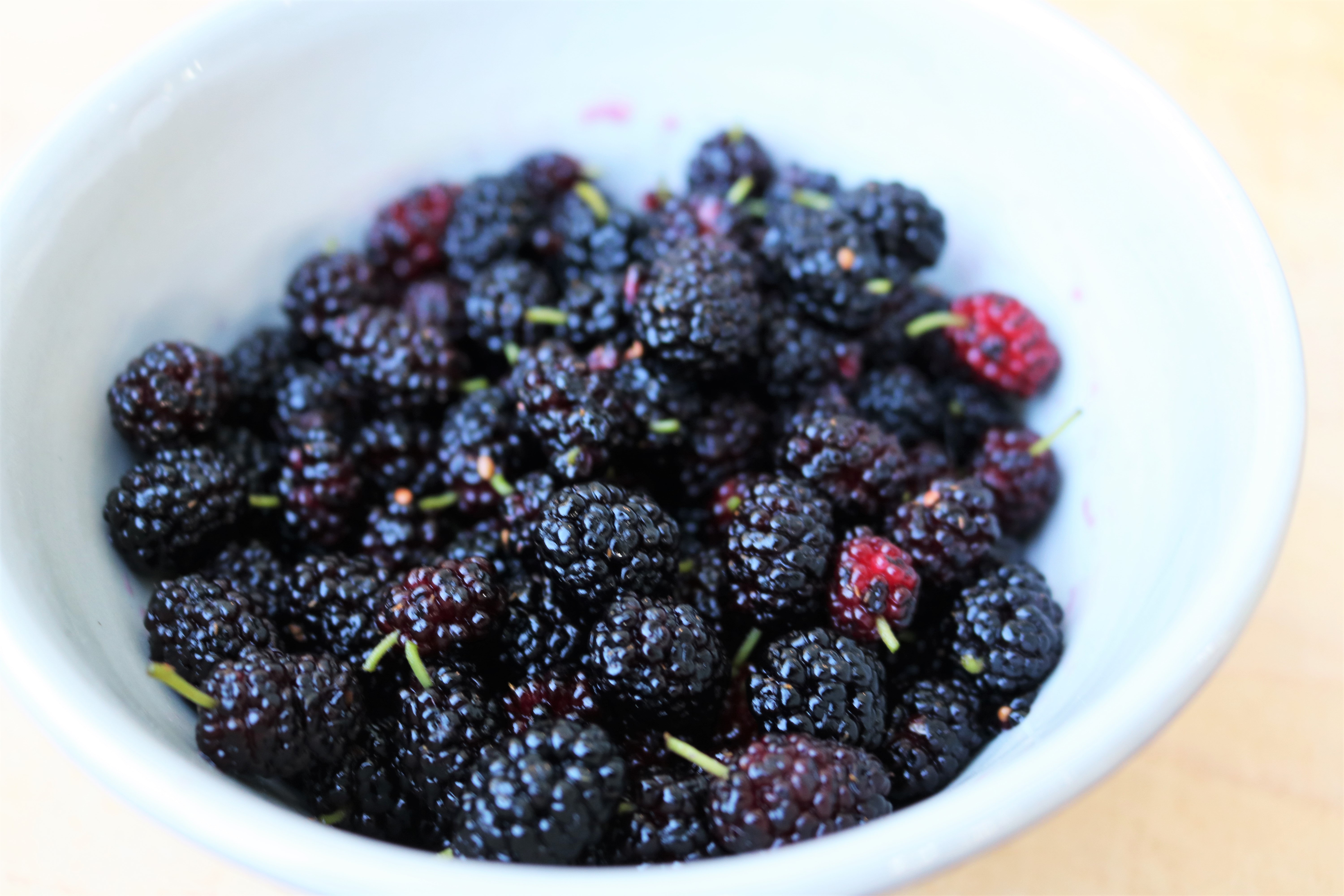
When we moved into our house, a weird, little tree was growing in the corner of our garden. I didn’t think much about it for a couple of years. One June I noticed berries forming on the branches. They looked like little blackberries. After doing some research, I discovered that this was a White Mulberry tree and that the mulberries were edible. We picked the dark juicy berries and popped them in our mouths. They are not quite as sweet as a blackberry, but they have a very nice taste that the whole family has grown to love.

People tend think mulberries and blackberries are almost the same fruit. While they do look a bit alike, they are actually very different. In fact, mulberries are not even a berry. They are a fruit that grows on a deciduous tree, whereas blackberries are a true berry belonging to the rose botanical family.

Summer Pickings

Ever since the mulberries first appeared on our tree, from mid-June to mid-July, I stop and nibble on these little darlings every time I pass under the branches. In fact, you can count on me taking three to four minutes extra every time I walk under it. One of the most enjoyable things about this tree is to listen and watch the robins go to town in the branches. They sing and fight with each other, but mostly they are busy stuffing their little beaks full of the nutritious, little berries.

People often call the mulberry tree a weed because said birds deposit the seeds elsewhere. For my part, I am glad they do. That, no doubt, is how we got ours. Next time, however, I will tell the birds to plant it on the back corner of our yard instead of the front corner, as I do spend a bit of time sweeping the berries off our sidewalk!

White Mulberry trees are quite a common tree in our region, probably for the above reason. They have an interesting trait in that they have leaves of three distinctly different shapes. One is unlobed, one is shaped a bit like a mitten, and one can look a little like a two-thumbed mitten. The tree originated in China where its leaves are used as the main food for the silkworm. The leaves are edible for humans if cooked first. They can be used in wrapping foods as you would with a grape leaf.

Cooking with Mulberries

This year I’m drying the berries to add to muffins and granola. They are also great served fresh in both savory and sweet dishes. After slightly crushing them, they are delicious sprinkled with superfine sugar and served over a lemon curd tart. They add depth to icy drinks by muddling them with fresh mint leaves. They make for a sweet/savory fresh salsa with lime and cilantro. I enjoy using them as an interesting counter to the savory taste of a bok choi salad. For breakfast, they are a great addition to crepes with brie cheese and cinnamon. Creating with these tasty little berries has kept my creativity working overtime.

Mulberry, brie cheese, and cinnamon crepes.

I love the idea of eating such an interesting berry from a tree that was planted by those chatty, fat robins, that many consider a nuisance. While mulberries don’t come close to matching the sweetness of raspberries or strawberries, I am thoroughly enjoying having this tree around. It is a part of my edible landscape. It truly is a multi-purpose tree: it feeds us, feeds the robin population, keeps us entertained, looks good with strands of twinkle lights wrapped around its branches, and provides nice shade and vertical dimension to that corner of the yard. We don’t dance around it singing nursery rhymes– wait! Maybe we should do that as well…

Mulberries over a lemon curd pie with homemade whipped cream.
Posted on 1 Comment

Rhubarb: The Vegetable That Thinks It’s a Fruit

The Heritage of Rhubarb

When I think of the classic plant that has anchored the corner of every Midwestern garden for the past century, I think of rhubarb. Some of my favorite dessert recipes are based on rhubarb. Rhubarb custard pie is oh, so delicious! I remember with fondness my Mom’s strawberry rhubarb freezer jam which we spread on warm toast. Warm Spilling Rhubarb over vanilla ice cream. My friend Jill Jorgensen’s gooey sweet Rhubarb Rolls. All these come from an unassuming plant that is so easy to grow you almost forget it’s even in your garden.

Rhubarb is a perennial vegetable that can flourish in most parts of the country. Rhubarb is delicious and easy to add to your garden. There are many recommended varieties to choose from. In my experience, the pinker the stems, the better they taste. Once planted, it can be left undisturbed to come back year after year.

Growing Rhubarb

Growing rhubarb is very simple. The plants make a nice addition to the perennial section of a vegetable garden or even a perennial landscape. In milder climates where they can overwinter without freezing, rhubarb also grows well in pots if you give it enough root space.

Spring is the perfect time to plant. Working some well-rotted compost or manure into the rhubarb bed will increase production. However, don’t pick any stems in in its first year. The plant needs all its foliage to help it establish a strong root system. In the second year, a small percentage of the stems can be harvested. In the third year and after, removing up to a third of the plant every year will keep it healthy and producing strong stems year after year. Dividing the plant every five years keeps the roots from getting too crowded. Which of your friends would turn down the offering of one or two baby rhubarb plants?

Uses of Rhubarb

Even though rhubarb had been used medicinally in China for thousands of years, its use as a food really started in England in the 17th century once sugar became available to counter its tartness. In the U.S., its use didn’t take off until the 1930s.

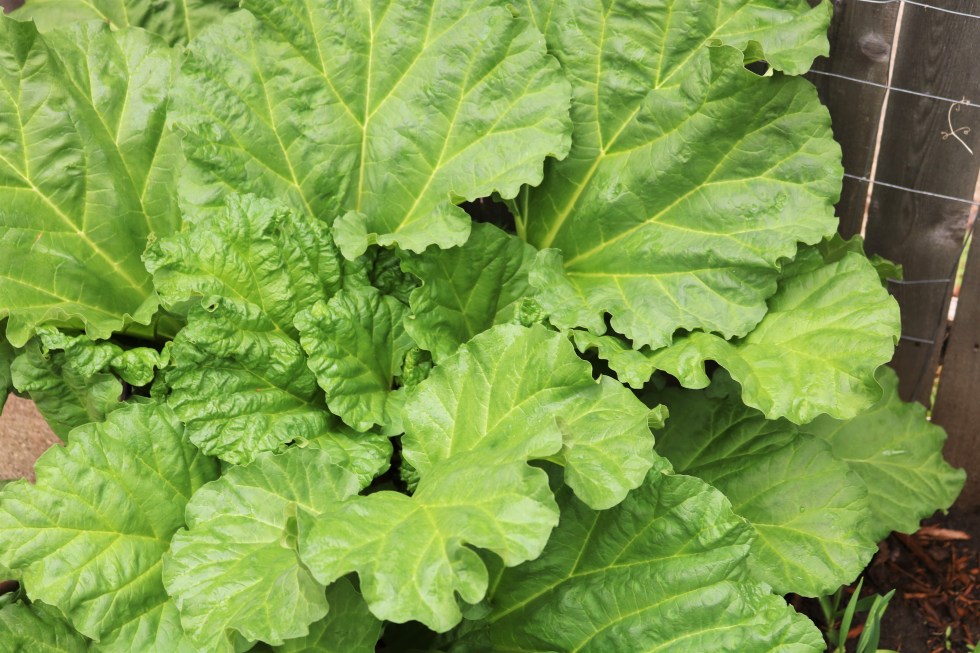
Nutritionally, rhubarb is high in fiber and loaded with vitamins, minerals, antioxidants, and phytochemicals. It can be a healthy addition to your diet if you curb the often added sugar. The stems (or petioles) are the only part of the plant we can cook and eat. The leaves contain oxalic acid, which is toxic to ingest and irritating to the skin if there’s prolonged contact.

Rhubarb is a great addition to desserts such as pie or crisp, cake, muffins, jams and jellies, and more. It is also great as a tart chutney over meat such as pork. My favorite completely unsweetened way to regularly include rhubarb is in fruit smoothies. The sweetness of the other fruits counters the tartness of the rhubarb, which lends a refreshing brightness to the final product.

Common Questions

  • Can you eat the leaves? No, they contain oxalic acid, which is toxic to humans. So throw away the leaves, and use the stems.
  • We just had a late spring frost that has damaged my rhubarb. Can I still eat the stems? No, when the plant has been affected by frost, the oxalic acid migrates from the leaves down into the stems, leaving them also toxic. If this has happened, throw away the whole plant. Look in your farmer’s market or grocery store for this year’s supply. If you live in a region prone to early or mid spring freezes, plant your rhubarb in a protected part of your yard. Last spring many in my area lost their rhubarb to freeze damage. Mine was spared because it is planted in a corner, protected on one side by a shed and on the other by a fence. The other option is to keep track of the weather forecast and cover it if a frost is on the horizon.

If you haven’t already, make this the year to add rhubarb to your yard. Like a long-time friend, it’ll always be there for you, but you never have to tend to it.


Posted on 1 Comment

The Invisible Glory of Dirt

What Happened to All the Dirt?

The new house we were moving into was in a section of town that was being carved out of native prairie. The neighborhood was located on a large (mostly) limestone plateau that looked out over the city below. I was excited. It was a large lot for a new subdivision. It was flat, and we had big plans for all that space. The final thing to happen before we moved in was for the contractor to grade the yard and lay down the sod. We had reserved a chunk in the very back for what would become our vegetable and flower garden. The rest they scraped and sodded. They said they had to do it so that we’d have a nice flat lawn. Our plan included flower beds surrounding the house and a stone patio with beds around that as well.

We moved in the fall, so when spring rolled around, we were ready, with shovels in hand, to create our flower beds. We pierced the ground with our shovels only to discover rock and clay hiding just below the surface. This was not the dark, rich soil we had envisioned. Our plants would not grow in this! Then we remembered; the native topsoil, teaming with living microorganisms, that was there originally had been scrapped away by those developing our neighborhood and by our builder as he leveled our lot.

Developing Good Dirt

At the time, we didn’t know a lot about dirt, but we knew enough to know the bulbs, flowering bushes, and perennials we had planned to put there weren’t going to thrive in rocky, clay soil.

So we decided to go about changing our dirt. First we carved the outlines of our beds. Next we removed all the dirt down about two feet. Truckloads of good, black dirt, compost, manure, and sand were dumped in tall piles on the end our driveway. We mixed these together, including some of the original dirt. Then we refilled all of our soon-to-be flowerbeds and vegetable garden with this new mixture.

All this work paid off in spades. We were rewarded with abundance in flowers, vegetables, and fruits. Though we didn’t know why exactly our plants thrived in healthy dirt, we saw the delicious and beautiful results.

The Microscopic World of Soil

Only relatively recently has the scientific community begun to put together all the many parts of what goes on under the ground in our soil. Scientists have historically thought that soil was made up of clay, sand, silt, and dead plant material. They didn’t know that in healthy soil the organic matter is almost completely made up of living and dead microbes. They are just beginning to understand how critical these microbes are to soil health and thus to plant health, and because we eat plants or eat animals that eat plants, to people health.

Life in the soil is mostly microscopic. What cannot be seen has not been understood. Now thanks to advances in scientific research, we are beginning to get a grasp on the role of bacteria, viruses, fungi, protists, archea, etc. The vast majority of these are extremely beneficial and essential to plant health.

Plant roots and the microorganisms that surround them have a mutually beneficial relationship. In a myriad of ways, this symbiosis makes our plants healthier. They have bigger root systems, and they have a much higher immunity to diseases. It has been shown they not only produce more fruits and vegetables, but those yields contain higher amounts of nutrients compared to plants grown in poor soil.

Creating Healthy Dirt

This begs the question, how can we get the healthiest soil possible? Of course, that is what we all want, right? Our solution over the past century has been to fertilize. If plants and soil need nitrogen, potassium, and phosphorus, let’s just give it to them. And we have … in abundance. The problem is that putting these minerals on the soil does not create healthy, living soil the plants need. Yes, the plants can grow large, but they are not growing better. They do not have the immunity to disease. They are not able to take advantage of the millions of organisms in the soil that make it possible for them to absorb necessary nutrients. Healthy soil absorbs and holds onto moisture better, making for more water for the plants as well as less runoff.

I liken it to the old adage, “Give a man a fish and he eats for a day. Teach him to fish and he eats for a lifetime.” Creating good soil is providing plants with the all the tools at nature’s disposal to flourish.

Enriching Your Soil

Healthy soil can be created almost anywhere by thinking through what you have at your disposal and faithfully applying it to your yard and garden.

It’s not unlike a recipe in your kitchen. Laying down compost and dried leaves in the fall (especially oak) grass clippings, wood mulch, compost tea, aged manure, even things like coffee grounds or fish emulsion. The more you add, the more food there is for the microorganisms to eat. This healthy soil makes for plants that can better fight off pests and diseases while bearing more produce.

As the saying goes, “We are what we eat.” And as it turns out, so are plants.

Spring is the perfect time to start creating great soil. Your landscapes are fairly bare, making it much easier to work with your soil. I would recommend just laying everything on the top of the ground. Don’t work it in. Trust me, the microbes will know where to find the food they need. It turns out the underground is like a microscopic city with infrastructure, pathways, and means of communication all set up. When we till, we destroy these established networks. Then it takes time to set it all back up again.

Soil experts and farmers around the world are only beginning to understand this and put into practice “no till” methods of farming. Farmers that practice just this one thing are seeing greater crops yields (as well as lower expenses because they are not spending the time and money it takes to till).

Try this: put away your chemicals, and instead feed your soil. Let’s see where this takes your yard and garden.
Soil is one of earth’s greatest assets, so let’s do what we can to make it better. The funny thing is, when we improve it, it will improve us.

Posted on 2 Comments

What Should You Plant First?

As early spring begins, I am starting to think about what seeds I want to plant in my garden beds for the first planting of the season. You are probably thinking it is too early to start thinking about one’s summer vegetable garden. However, this is the ideal time to plan and purchase those first seeds. Some of the most interesting varieties of seeds sell out fairly quickly, so once you know what you’re hoping to plant, get the seeds while they are still available.

A number of types of vegetables thrive in the cool, wet days of spring. Many plants need this weather to really do well.  I take the temperature of my garden soil, and when it’s around 50 degrees, it is time to plant.

The vegetables I am planting this early spring include:

Radishes

Last year I planted “D’Avignon,” the traditional French breakfast radish. This year I am trying two very different varieties. Early Scarlet Globe is a very dependable radish. It is ready in 20 to 28 days, so we can enjoy eating them early. And because I like to try new things, I am planting Purple Plum, a purple radish with a great flavor. A second new venture for me is Watermelon, a white radish with a stunning, dark pink center. This variety shines in the very early spring. It lends itself well to pickling, so I may play around with doing that later this spring.

Sweet Peas

I’m going all out on three completely new varieties of snap or snow peas this year. I chose two from Seed Savers Exchange (an organization that preserves historic and heritage varieties of seeds, saving them and also reproducing some for sale) The first pea variety is the Amish Snap. This is a pea that was been grown by the Amish community long before our present varieties existed. It vines tall and vigorous. The other choice from Seed Savers is Swenson Swedish. This heirloom variety was brought to Minnesota from Sweden in 1876. It is sweet, flavorful, and productive.

Another seed company that is doing great work in preserving rare and heirloom varieties is Baker Creek Heirloom Seeds out of Missouri. I chose my third variety of sweet pea from them. This hypertendril snap pea produces more tendrils instead of some of its leaves. These, along with the beautiful pink blossoms, are deliciously edible and taste just like peas.

Lettuce

With lettuce I like to plant several kinds. I start early in the spring and reseed several times throughout the summer so I have a constant supply. I am planting two mixes, a Mesclun blend that contains some peppery lettuce varieties and a lettuce blend. All the Romaine lettuces are wonderful, so this year I am planting Red Romaine. A large variety, it is both a colorful and tasty addition to salads. Lastly, I am planting an English variety Craquerelle du Midi, sweet and crisp with dark green curled leaves. Its slowness to bolt in the heat of summer is another desired trait.

Carrots

I am starting with two varieties of carrots this year. One is an old faithful I have used for years, Scarlet Nantes. It is sweet, tender, and a proven producer. The other is a red carrot called Dragon. I love the beauty of red carrots. This tasty variety is red on the outside and orange in the center.

Arugula

The arugula I planted last year will come up again this year. I am also, however, planting a bitey variety that will nicely complement what is already out in my garden. Wasabi arugula has the spicy taste of wasabi, a very helpful addition to Asian dishes. It is more tolerant of swings in weather than other varieties. I’ll also be picking the edible blossoms to throw into salads or pasta dishes.

Kale

Lacianto Dinosaur is my kale choice this time around. This Tuscan variety dates back to at least the early 1800s. It is beautiful with dark green, deeply savoyed leaves. It is quite flavorful, making for a fabulous addition to soups and stews. This grouping of vegetables prefers the cool wetness of spring. At least a month before the final frost, I am out cleaning my garden beds and burying the these little nuggets in the ground. They don’t mind a little snow, frost, and cold spring rainstorms. They get to work, germinating and soon popping their little heads through the surface of the earth. The unsuspecting surprise of eating sweet lettuces or crunchy peas in the middle of May when most of us are just starting to put in our summer vegetables is refreshing indeed.

These early vegetables in an otherwise dormant space is like spring opening her door and saying, “Welcome to my home.” And, in fact, welcome it is!

Posted on Leave a comment

Microgreens in the Winter

Why Microgreens?

I am thinking about them right now in the colder months because they grow so easily inside. Microgreens are defined as the edible, immature greens that are harvested about two weeks after germination. Little pea shoots, the tiny leaves and stems from broccoli, kale, amaranth, red cabbage, and sunflowers; these are a few of the more common types of microgreens.

The Uses for Microgreens

They can be used in a myriad of ways including as a confetti topping on an open-faced sandwich or pizza, tossed as a salad, or as a refreshing accompaniment to any braise. I love including them in cold quinoa or rice salads because the raw crunch adds not only depth but also beauty to the dish. Try them in a wrap or a soup. Mix them into your breakfast smoothie. They are a tasty reminder of summer.

IMG_3852 (2)

Research done by the USDA has shown that microgreens are many times more concentrated in a wide variety of nutrients than their adult counterparts. Research is still being done on these jewels that pack so much nutritional punch, but in the meantime, eat and enjoy knowing you are eating something good for your health.

Growing your Own Greens

I buy my microgreens at out local co-op store. I love that they are locally grown. However, if you would like to grow your own, it is very easy. Any disposable tray or pie plate will work. Poke a few holes in the bottom for drainage, fill it with moistened potting soil, and sprinkle your chosen seeds per instructions on their packets. Usually you just barely cover the seeds with more soil. Water the soil by misting it with water a couple times a day. You want to keep the soil moist but not wet. Place the tray in your sunniest window or under grow lights. The plants should get about four hours of sunshine each day.

Next time you are building a turkey, vegetable sandwich, include baby pea sprouts instead of that leaf of romaine. You will love it!

IMG_4031 (2)

Posted on Leave a comment

Garden Planning on a Cold Winter’s Day

Thinking of Spring

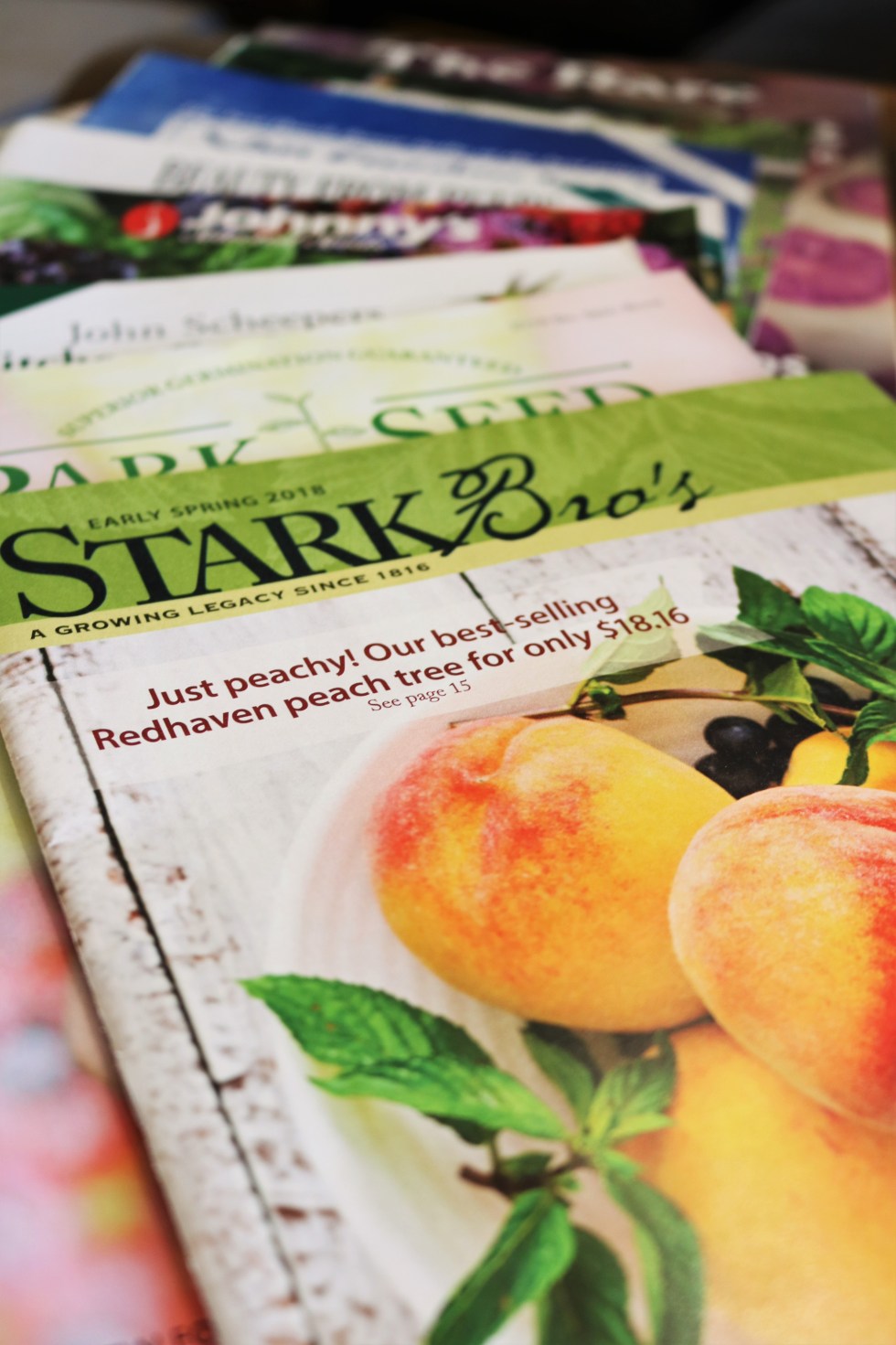
We are in the midst of a blizzard. Mother nature is dumping heavy, wet snow, yet inside my cozy house the growing stack of seed catalogs is whetting my appetite for summer. Johnny’s Selected Seeds has introduced “the first-ever red-colored Chinese cabbage with full-sized heads.” Park Seed has just introduced a bi-colored Echinacea where “yellow petal tips give way to magenta-red on these large, very abundant blooms.” I once again have zone 5 envy as I read about Spark Bros’ new variety of Honeycrisp/Gala apple cross.

My garden is buried, and the branches of my mulberry tree stark. However, I am starting to think, plan, and drool at the promise of a new variety of tomato. The juicy, sweet German Pink variety ensures greater disease resistance and heavier yields.

IMG_4232 (2)

Creating a Garden Plan

These cold, winter months give me time to reflect. What worked last summer? What do I want to do differently? Should I plant more pollinator-friendly plantings? How about more climbing vegetables? I love using my fence for vining peas, beans, cucumbers, and melons. Unfortunately it seems the most interesting seed varieties tend to sell out quickly. For that reason, if there is something I particularly want to try, I need to order soon. These deep, cold temps are essential for many of our native trees and plants, so I do not wish for a warm winter.

The variety of seasons offers a change of pace in our schedules. For me, on this wintry day, I am curled up with a mug of Chai tea with the strains of violin music in the background. A pine-scented candle burns as I nestle up with my garden planning book and seed catalogs.

IMG_4624 (2)

Posted on Leave a comment

Beets

Attributes of the Beet

This deep ruby-colored globe is as delicately flexible to use in your cooking as it is beautiful to behold. The National Garden Bureau has named this “The Year of the Beet.” A justly deserved honor this is!

Beets are an obliging workhorse in the garden. They thrive in a variety of conditions, easily started in spring, after the last frost and not resowed until early August. They prefer slightly acidic soil (pH greater than 6.0) and are fine with a sunny or part-sunny spot.

IMG_4280 (2)
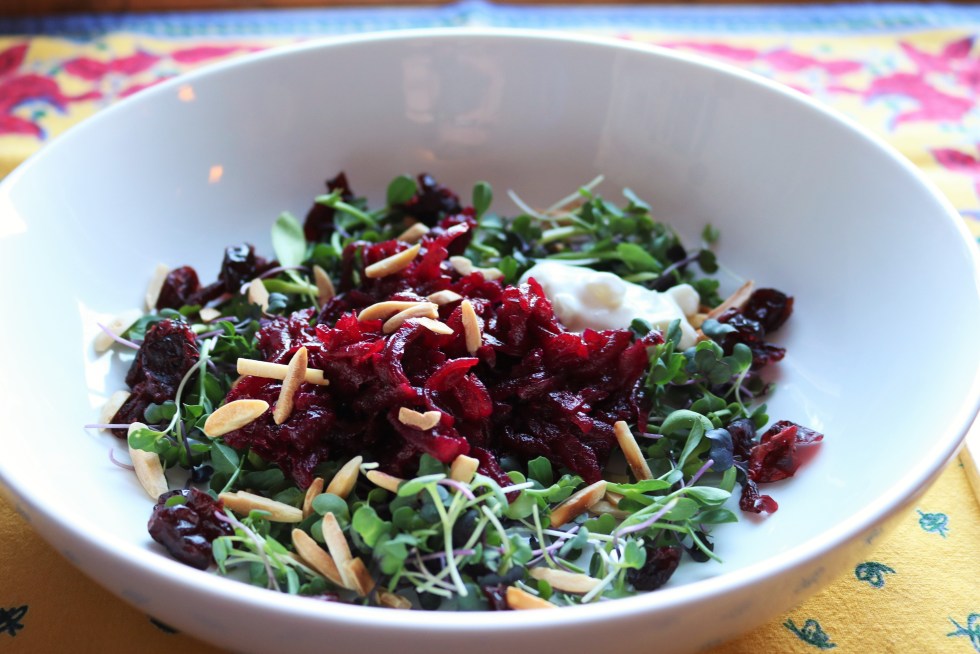
Microgreen salad with shredded beets, toasted almonds, crème fraîche, and dried cranberries in an oil balsamic vinaigrette.

Cooking with Beets

Both the leaves and the root are delicious and packed full of nutrients. I love beets roasted with a little olive oil and sea salt, used as one of the essential ingredients of Russian Borscht stew or boiled then tossed with goat cheese, crisp apple wedges in a toothsome salad. Likewise, the greens contribute well to soups, salads, or even smoothies. Because of their high nutritional value, they’ve taken the health-conscious world by storm. You can buy everything from beet pills or juice to beet powder.

Nothing, however, replaces a good old chunk of roasted beet.

Let’s explore together this versatile vegetable. From its humble beginnings all covered with loamy brown dirt to a rich garnet sliver poking out of a meaty braise, let’s celebrate the year of the beet.

IMG_3828 (2)